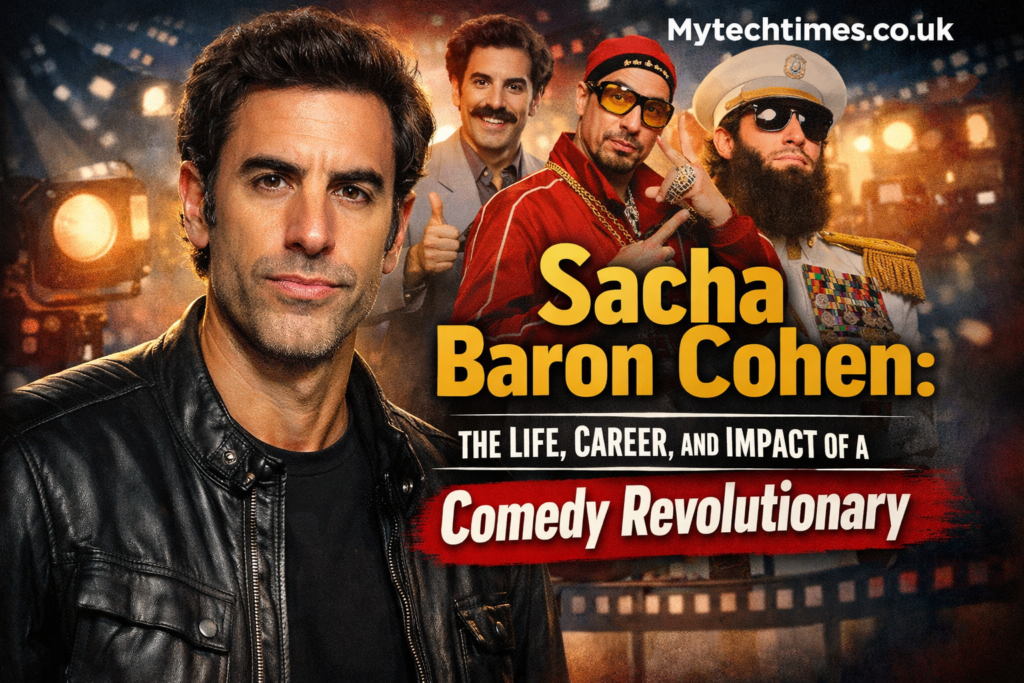

Sacha Baron Cohen is widely recognized as one of the most daring, unconventional, and controversial figures in modern comedy. Known for his fearless approach to satire and his ability to fully immerse himself in outrageous characters, he has built a career that blends humor, social commentary, and sharp political critique. Unlike many comedians, Cohen doesn’t simply tell jokes—he creates immersive, often provocative scenarios that expose social prejudices, political hypocrisy, and cultural contradictions. His work has pushed the boundaries of comedy while also sparking global debates about ethics, media, and the role of satire in society.
Born in London, England, Cohen grew up in a Jewish family and initially pursued academic studies at the University of Cambridge, where he studied history. However, his passion for performance and satire led him toward a career in entertainment, where he would eventually redefine the limits of comedic performance.
Early Life and Educational Background
Cohen was born on October 13, 1971, in London. His upbringing played a significant role in shaping his comedic style. Coming from a family that valued both culture and intellectual engagement, he was exposed to diverse perspectives from an early age. His education at Cambridge University was particularly influential, as it was there that he began experimenting with character-based comedy and political satire.
While at Cambridge, Cohen joined the Cambridge Footlights, a famous amateur theatrical club that has produced many successful comedians and actors. This environment allowed him to refine his skills in writing, performance, and improvisation. It was during this time that he began developing the bold, character-driven style that would later define his career.
Breakthrough with Iconic Characters
Cohen rise to fame began with the creation of fictional characters that he portrayed in various formats, including television, film, and public appearances. His breakthrough came with the character Ali G, a fictional hip-hop journalist with exaggerated street slang and a satirical take on youth culture.
The success of Ali G led to the television show Da Ali G Show, which introduced audiences to Cohen other iconic characters, including Borat Sagdiyev, a naïve and politically incorrect journalist from Kazakhstan, and Bruno, an outrageous Austrian fashion reporter. Each character allowed Cohen to explore different aspects of society, often placing real people in uncomfortable or absurd situations to reveal their true beliefs and reactions.
Borat and Global Fame
One of Cohen most famous creations is the character Borat, who became the subject of the hit mockumentary film Borat: Cultural Learnings of America for Make Benefit Glorious Nation of Kazakhstan. The film followed Borat as he traveled across the United States, interacting with unsuspecting individuals and exposing social attitudes toward race, gender, and politics.
The film was both a critical and commercial success, earning Cohen widespread recognition and an Academy Award nomination for Best Adapted Screenplay. It also sparked controversy due to its use of real people who were unaware they were part of a comedic performance. Despite the controversy, the film is often praised for its bold satire and its ability to challenge societal norms.
A sequel, Borat Subsequent Moviefilm, was released years later and continued the character’s satirical exploration of contemporary political issues. This film further demonstrated Cohen’s ability to adapt his humor to changing global contexts while maintaining his provocative style.
The Bruno Persona and Fashion Satire
Another of Cohen notable characters is Bruno, an eccentric Austrian fashion journalist known for his outrageous behavior and flamboyant personality. The character was featured in the film Brüno, which explored the world of fashion, celebrity culture, and media sensationalism.
Through Bruno, Cohen satirized the obsession with fame and the often absurd nature of the fashion industry. Like his other characters, Bruno interacted with real people, often leading to uncomfortable or shocking situations. The film received mixed reviews but was praised for its boldness and fearless approach to controversial topics.
Political Satire and The Dictator
Cohen continued to push boundaries with his 2012 film The Dictator, where he portrayed a fictional authoritarian leader. The film parodied dictatorships and political regimes, using humor to critique power, oppression, and global politics.
Unlike his earlier mockumentaries, The Dictator featured a more traditional narrative structure, though it retained Cohen’s signature comedic style. The film highlighted his ability to blend satire with scripted storytelling, expanding his range as an actor and comedian.
Awards and Recognition
Throughout his career, Cohen has received numerous awards and accolades for his work in comedy and film. He has been nominated for Academy Awards, Golden Globe Awards, and BAFTA Awards, among others. His performance in films like Borat and The Trial of the Chicago 7 showcased his versatility as both a comedic and dramatic actor.
Cohen role in The Trial of the Chicago 7 marked a significant departure from his comedic persona, as he portrayed activist Abbie Hoffman in a serious historical drama. His performance was widely praised and earned him several award nominations, proving that he is not limited to comedy alone.
Activism and Social Impact
Cohen is known for his activism and involvement in social causes. He has used his platform to advocate for issues such as human rights, freedom of speech, and social justice. His speeches at award ceremonies and public appearances often address political and social issues, reinforcing his commitment to using comedy as a tool for change.
Cohen has also been involved in charitable work and has supported various organizations that focus on humanitarian efforts. His work often blurs the line between entertainment and activism, demonstrating his belief that comedy can play a powerful role in shaping public discourse.
Controversies and Criticism
Cohen career has not been without controversy. His style of comedy often involves placing real people in uncomfortable or misleading situations, which has led to criticism regarding ethics and consent. Some individuals featured in his projects have expressed dissatisfaction, claiming they were misled or portrayed unfairly.
Despite this criticism, many supporters argue that Cohen’s work serves a greater purpose by exposing underlying social prejudices and biases. His ability to provoke strong reactions is often seen as a hallmark of effective satire, even if it occasionally crosses ethical boundaries.
Acting Beyond Comedy
While Cohen is best known for his comedic roles, he has also demonstrated significant acting range in more serious roles. His performance in films like The Trial of the Chicago 7 showcased his dramatic abilities and earned him critical acclaim. This shift highlights his versatility and willingness to challenge himself as an artist.
In addition to film, Cohen has appeared in various television projects and continues to explore new opportunities in the entertainment industry. His ability to transition between comedy and drama has solidified his reputation as a multifaceted performer.
Legacy and Influence
The legacy of Sacha Baron Cohen is defined by his fearless approach to comedy and his willingness to challenge societal norms. He has influenced a generation of comedians and filmmakers who admire his boldness and creativity. His work has redefined what comedy can achieve, demonstrating that humor can be both entertaining and thought-provoking.
Cohen characters and films continue to be studied and discussed in academic and cultural contexts, highlighting their significance in modern media. His ability to blend humor with social commentary has made him one of the most influential comedic figures of his time.
Read More: Selena Quintanilla: The Life, Legacy, and Lasting Influence of the Queen of Tejano Music
Conclusion
Sacha Baron Cohen career is a testament to the power of satire and the impact of fearless storytelling. From his early days at Cambridge to his rise as a global comedic icon, he has consistently pushed boundaries and challenged audiences to think critically about the world around them. His work has sparked laughter, controversy, and important conversations about society, politics, and human behavior.
Whether through outrageous characters like Borat and Bruno or his more serious dramatic roles, Cohen continues to evolve as an artist while maintaining his unique voice. His contributions to comedy and film have left an indelible mark on the entertainment industry, ensuring that his influence will be felt for years to come.