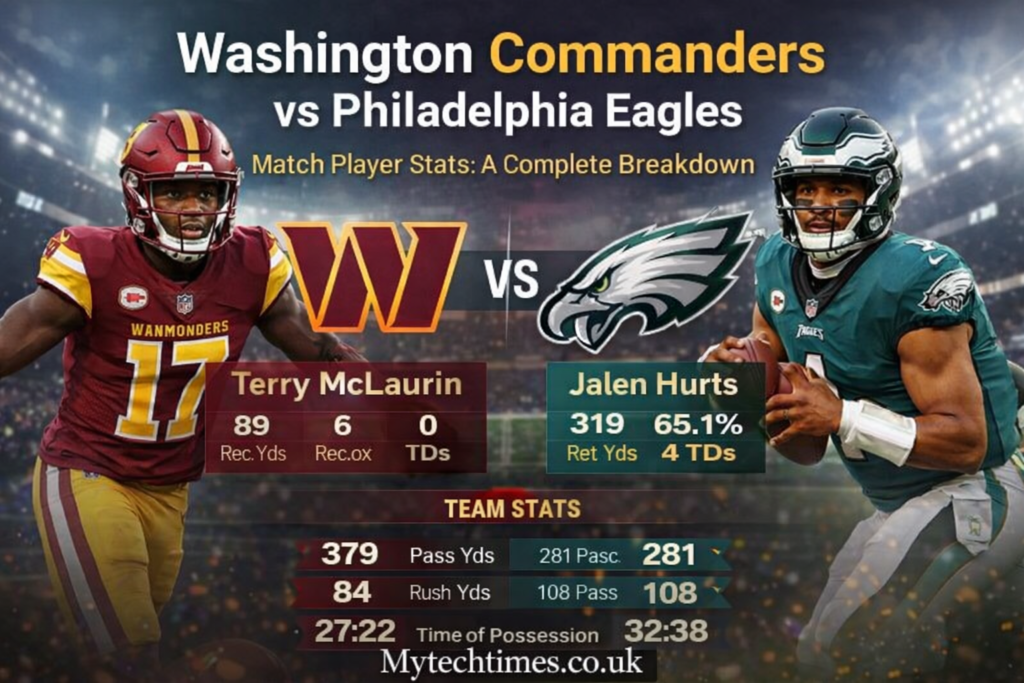

The matchup between the Washington Commanders and the Philadelphia Eagles is one of the most closely watched contests in the NFC East division. Both teams share a long-standing rivalry filled with competitive games, dramatic finishes, and standout individual performances. When analyzing any matchup between these two franchises, player statistics play a crucial role in understanding how the game unfolds and which team gains the upper hand. This article takes a deep dive into the player stats from a typical Washington Commanders vs Philadelphia Eagles game, focusing on offensive, defensive, and special teams contributions, while also examining key players who often influence the outcome.
Quarterback Performance and Passing Statistics
Quarterback play is often the defining factor in a Commanders vs Eagles matchup. On the Philadelphia side, the Eagles typically rely on a dynamic dual-threat quarterback who excels both in passing accuracy and rushing ability. Their quarterback often records impressive passing yards, high completion percentages, and multiple touchdown passes, while also contributing rushing yards that keep defenses off balance. For instance, in recent matchups, Eagles quarterbacks have consistently surpassed 200–300 passing yards, completing over 65% of their passes with minimal turnovers, showcasing efficiency and precision.
On the Washington side, the Commanders’ quarterback performance has varied depending on the season and roster composition. However, when performing at a high level, the Commanders’ quarterback can also produce solid passing stats, often ranging between 180–250 passing yards per game. Completion percentages, touchdown-to-interception ratios, and decision-making under pressure are key metrics that determine success. In many cases, Washington quarterbacks face strong defensive pressure from the Eagles’ front line, which impacts their time in the pocket and overall passing efficiency. The comparison of quarterback stats between these two teams often reveals a significant edge in consistency for Philadelphia.
Running Game and Rushing Statistics
The rushing attack is another critical element in Washington Commanders vs Philadelphia Eagles matchups. The Eagles have historically built a strong ground game, often ranking among the top rushing teams in the league. Their running backs, along with the quarterback’s rushing contributions, frequently accumulate over 120–150 rushing yards per game. These stats are supported by a strong offensive line that creates running lanes and controls the line of scrimmage.
The Washington Commanders’ rushing performance tends to be more inconsistent but still capable of explosive plays. Their running backs typically average between 80–120 rushing yards per game, depending on game flow and offensive strategy. Key metrics include yards per carry, red zone efficiency, and the number of rushing touchdowns. When Washington establishes a strong running game, it helps control possession and reduce pressure on their quarterback, which is essential when facing a high-powered offense like Philadelphia’s.
Wide Receivers and Passing Game Contributions
Wide receivers play a crucial role in shaping the passing stats in this matchup. The Eagles often feature a star wide receiver who dominates the stat sheet with 80–120 receiving yards per game, along with multiple receptions and occasional touchdowns. Their passing game benefits from deep-threat capabilities and yards after catch (YAC), making their receivers a constant threat.
The Commanders’ receiving corps, while sometimes less explosive, still contributes significantly to the team’s offensive output. Their top receivers may record 60–100 receiving yards per game, depending on defensive coverage and quarterback performance. Key metrics such as targets, catch rate, and third-down conversions are especially important for Washington, as they often rely on short to intermediate passes to move the chains.
Comparing the two teams, the Eagles usually hold an advantage in explosive plays and deep passing stats, while the Commanders focus more on ball control and efficiency. However, individual standout performances can swing the game in either direction, especially when receivers find gaps in the secondary.
Defensive Player Stats and Impact
Defense is often the deciding factor in close games between these two rivals. The Philadelphia Eagles typically boast a strong defensive unit, with defensive linemen and linebackers contributing to high sack totals, tackles for loss, and quarterback pressures. In a typical game, the Eagles may record 2–5 sacks, multiple quarterback hits, and several tackles behind the line of scrimmage. Their secondary also contributes with pass breakups and interceptions, limiting big plays from the opposing offense.
The Washington Commanders’ defense is known for its resilience and ability to create turnovers. Their defensive line is often one of the strongest units, capable of generating pressure and disrupting offensive rhythm. Key stats for Washington defenders include sacks, forced fumbles, interceptions, and total tackles. In many matchups, the Commanders’ defense keeps the game competitive by limiting scoring opportunities and forcing key turnovers at critical moments.
Linebackers from both teams also play an essential role in run stopping and pass coverage. Their tackle counts often exceed 6–10 tackles per game, highlighting their involvement in nearly every defensive play. The defensive battle in this rivalry is intense, and player stats on this side of the ball often reflect the physical nature of the game.
Special Teams Contributions and Hidden Stats
While often overlooked, special teams can have a significant impact on Washington Commanders vs Philadelphia Eagles match player stats. Kickers from both teams are frequently called upon to make field goals, sometimes under high-pressure situations. Field goal accuracy, extra points, and long-distance kicking attempts are key stats that can decide close games.
Punt returners and kick returners also contribute to field position, which indirectly affects offensive and defensive stats. A strong return game can lead to shorter fields for the offense and better scoring opportunities. Average return yards, longest returns, and return touchdowns are important metrics in evaluating special teams performance.
In tightly contested games, even a single blocked punt, missed field goal, or long return can shift momentum and alter the statistical outcome of the game. Therefore, special teams stats should not be ignored when analyzing this matchup.
Key Players to Watch in Statistical Matchups
Every Washington Commanders vs Philadelphia Eagles game features key players whose statistics stand out. On the Eagles side, their quarterback, star wide receiver, and dominant defensive linemen are usually the statistical leaders. These players often accumulate the highest passing yards, receiving yards, sacks, and turnovers.
For the Commanders, key players include their quarterback, top running back, and standout defenders. These individuals are responsible for generating the majority of offensive production and defensive stops. Player matchups, such as a star receiver against a top cornerback, often result in compelling statistical battles that shape the game.
Analyzing these individual performances helps provide deeper insight into how each team performs as a unit. High statistical output from key players often correlates with team success, while underperformance can lead to losses.
Turnovers, Efficiency, and Advanced Metrics
Beyond basic stats, advanced metrics such as turnover differential, third-down conversion rate, and red zone efficiency are critical in evaluating the Washington Commanders vs Philadelphia Eagles matchup. The Eagles often excel in minimizing turnovers while maximizing scoring efficiency, which gives them an advantage in tightly contested games.
The Commanders, on the other hand, rely heavily on creating turnovers and capitalizing on opponent mistakes. Interceptions, fumble recoveries, and defensive scoring plays can significantly boost their chances of winning. Turnover differential is often one of the most telling statistics in determining the outcome of these matchups.
Third-down conversion rates also reveal how well each team sustains drives. A higher conversion rate indicates better offensive efficiency and the ability to stay on the field longer. Red zone efficiency is another critical stat, showing how often teams convert scoring opportunities into touchdowns rather than field goals.
Read More: Paula Profit: Life, Background, and Public Attention
Conclusion
Washington Commanders vs Philadelphia Eagles match player stats provides a comprehensive understanding of how these two teams compete at a high level. The Eagles typically hold an edge in offensive firepower, particularly in passing and rushing efficiency, while the Commanders rely on defensive strength and opportunistic plays to stay competitive. Quarterback performance, rushing yards, receiving contributions, defensive stats, and special teams all play a vital role in shaping the outcome.
This rivalry continues to deliver exciting games filled with statistical milestones and standout performances. Whether it’s a high-scoring offensive showdown or a defensive battle, the player stats from each matchup offer valuable insights into team strategies and individual excellence. Fans and analysts alike closely examine these numbers to predict future outcomes and appreciate the depth of talent on both sides.
The Washington Commanders vs Philadelphia Eagles matchup is more than just a game—it is a statistical battle that highlights the best and most competitive aspects of professional football.